

Work
About
Resume
Yaeum
A mobile app for learning Korean vocabulary through K-pop, K-dramas, and real texts
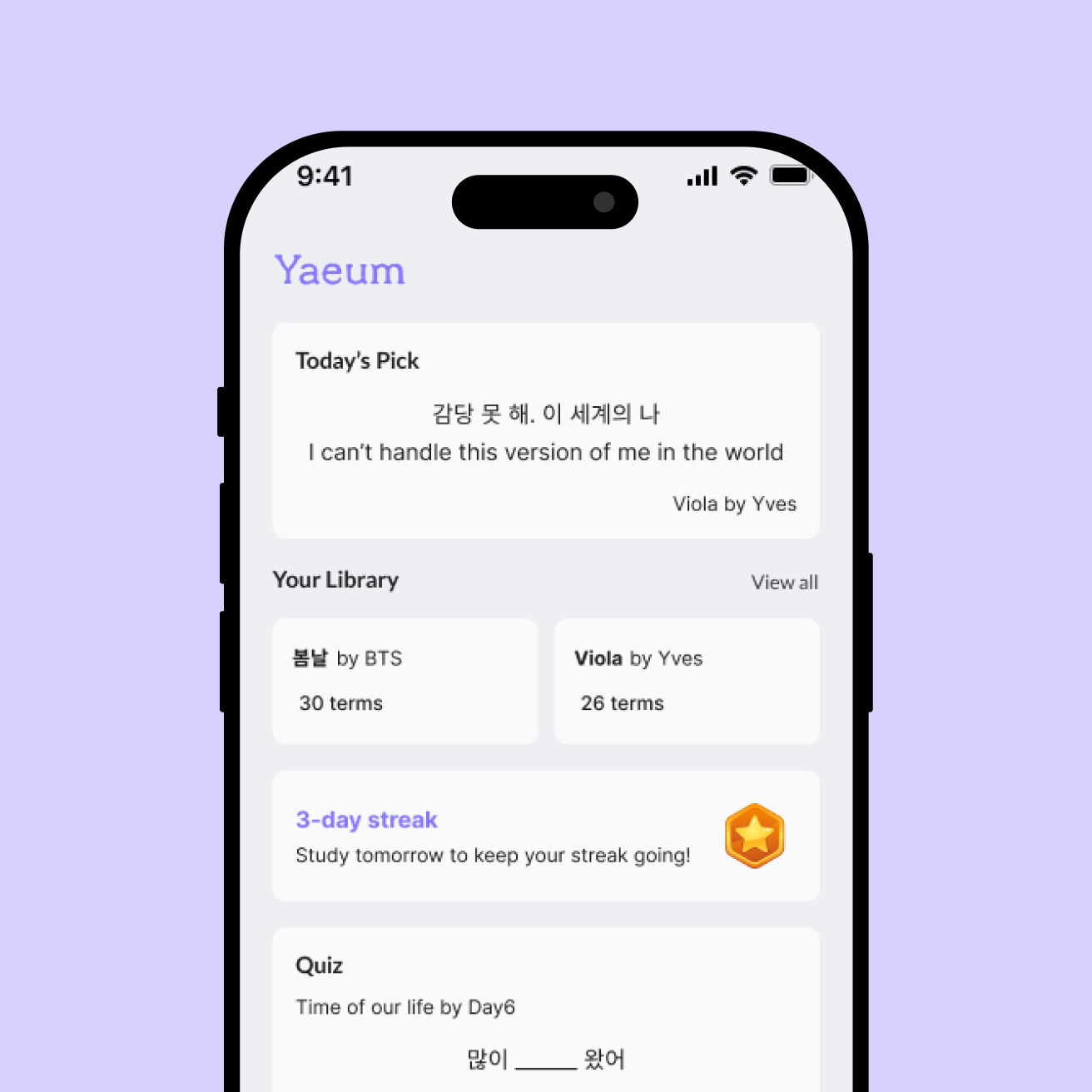
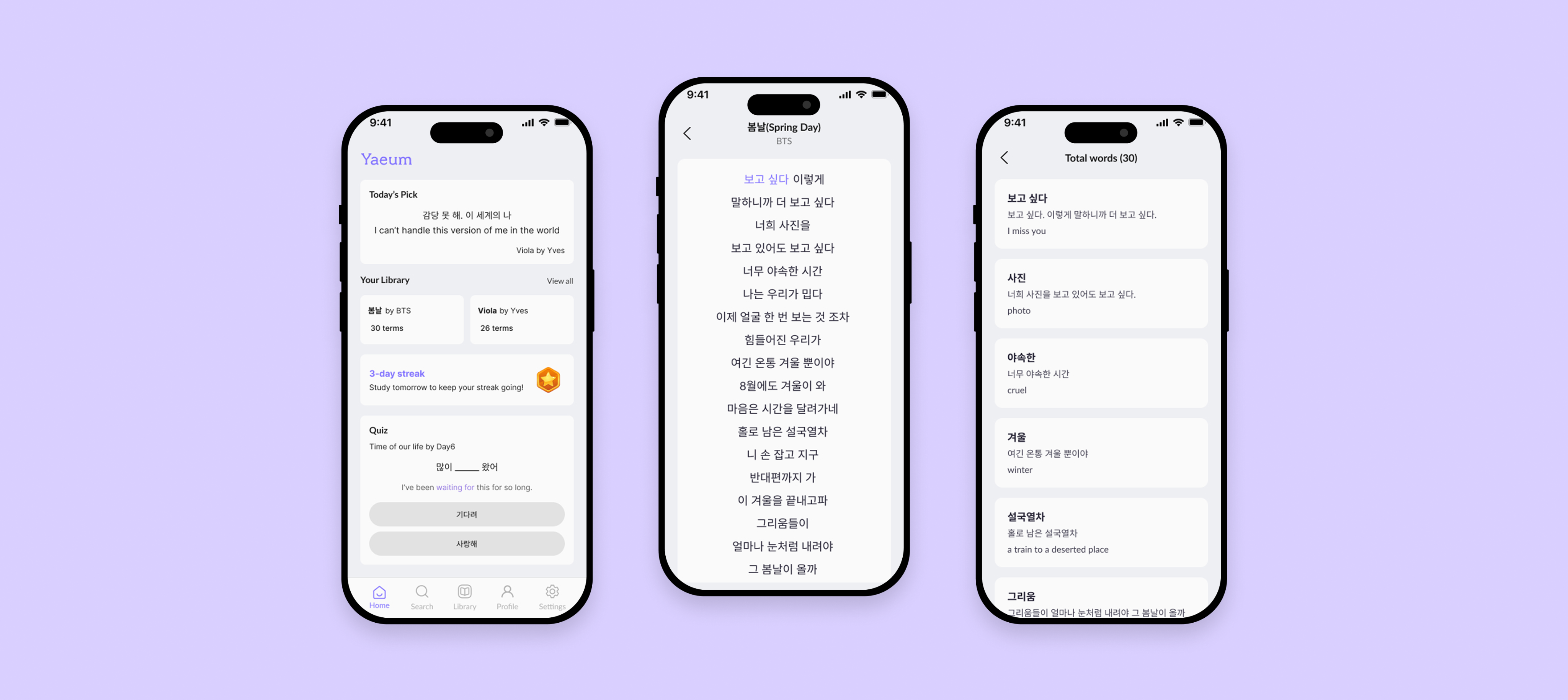
Yaeum is a mobile app that helps learners build Korean vocabulary using content they love, such as K-pop lyrics, K-dramas. By turning real Korean content into personalized word lists and quizzes, Yaeum makes vocabulary learning more relevant, engaging, and effective.
Background
When Motivation Isn’t the Problem
Many of my foreign friends who are learning Korean turn to K-pop and Korean dramas as one of their primary ways to build vocabulary. These moments are when motivation is highest, and learning feels immersive rather than academic.
However, I noticed a recurring frustration. When unfamiliar words or sentences appeared, they would pause the content and look them up using Google or dictionary apps. While this behavior showed strong curiosity, it happened repeatedly and resulted in vocabulary being scattered across searches, notes, and screenshots.
Over time, these in-the-moment lookups rarely turned into structured learning. Words were forgotten, lists were not revisited, and the learning experience became fragmented and inefficient.
This observation made me realize that the problem was not motivation, but the lack of a system to organize and reuse vocabulary encountered through content. This insight became the starting point for Yaeum.


Research
Learning Korean through K-Content
To validate these observations, I studied how beginner to intermediate learners engage with Korean through K-content. While they often look up unfamiliar words and take notes in the moment, the lack of structure and continuity leads to fragmented vocabulary learning. These insights were derived from interviews.
In-the-moment learning: Learners tend to look up vocabulary only when curiosity arises during content consumption, rather than through planned study sessions.
Fragmented workflows: Switching between music or video platforms, search engines, and note-taking tools disrupts immersion and learning momentum.
High effort, low retention: Although learners invest time searching and writing down words, these vocabulary lists are rarely revisited or effectively retained.
Approach
Turning moments of curiosity into Korean learning
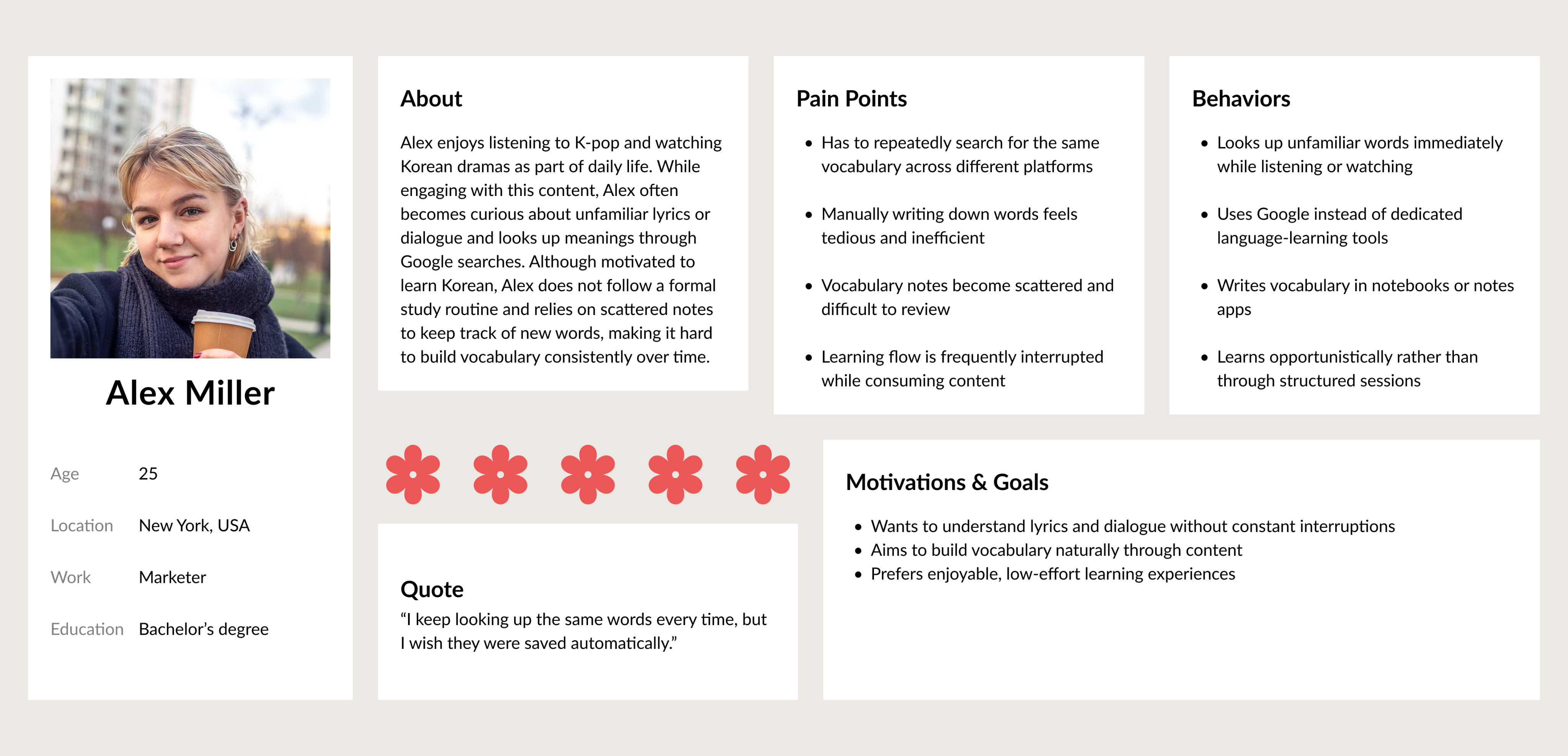
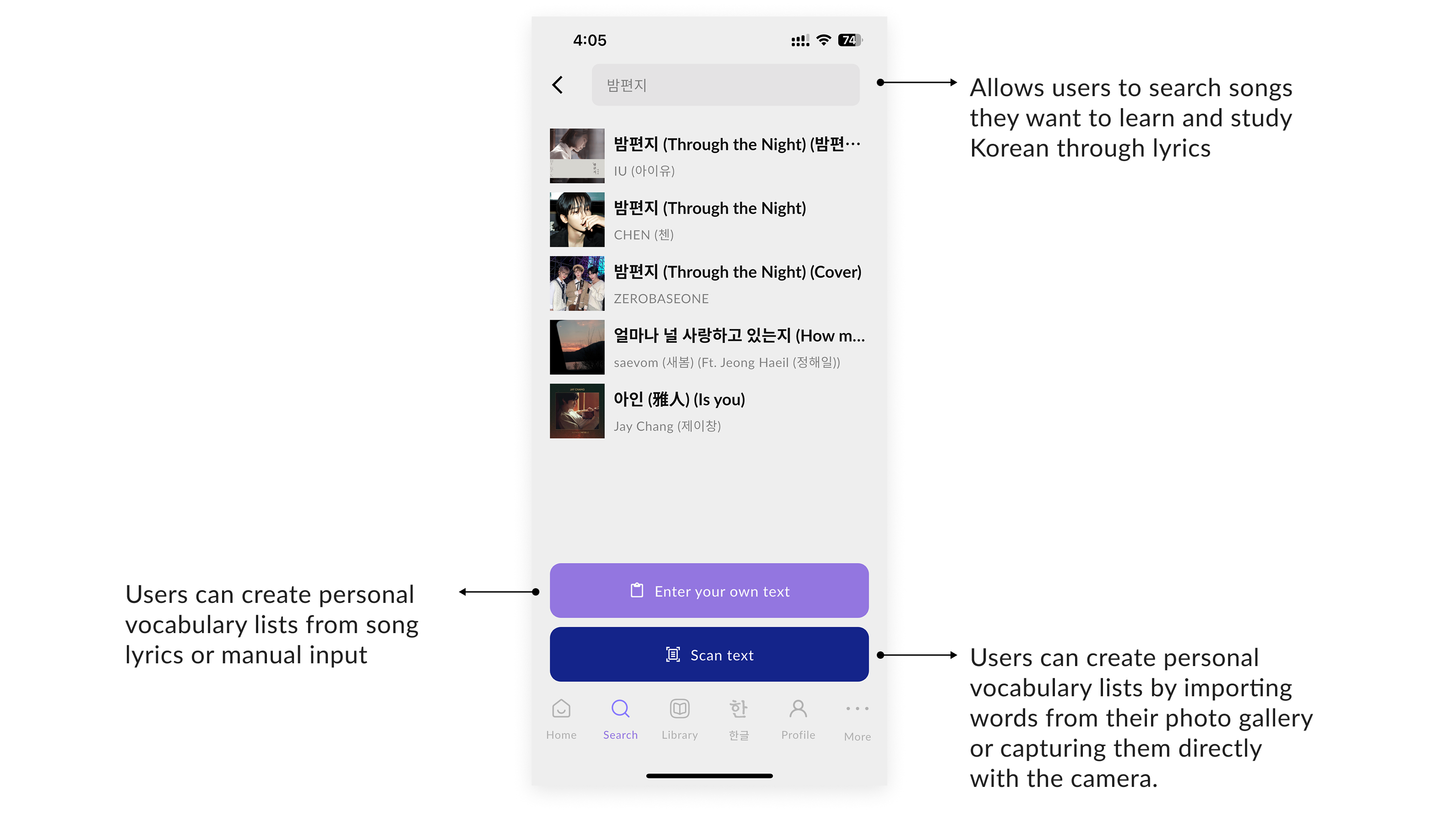
Creating a user persona named Alex from interview insights, I developed an experience map to empathize with her journey of learning Korean through K-content. This led to the idea of a service that allows users to search for music and receive vocabulary lists and quiz exercises generated from song lyrics. The main functionality focuses on helping users stay engaged in language learning through vocabulary study and quizzes based on real Korean content.
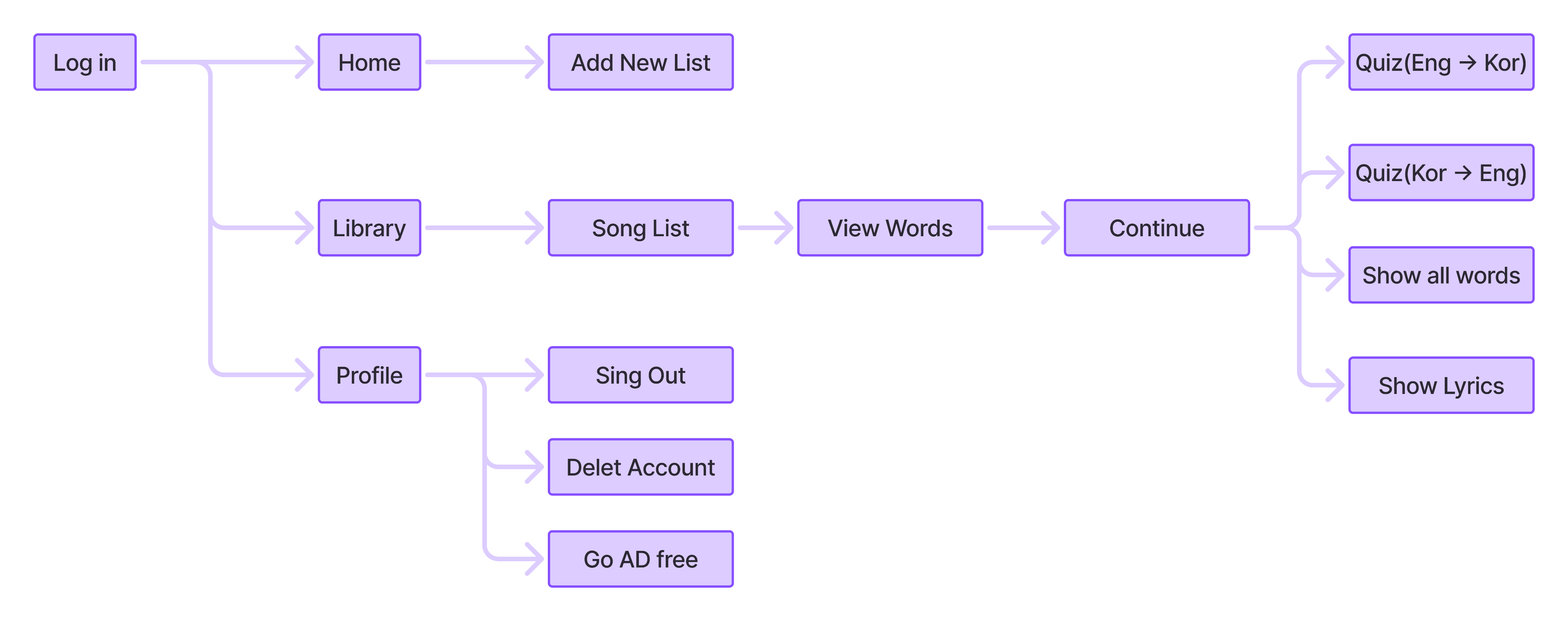
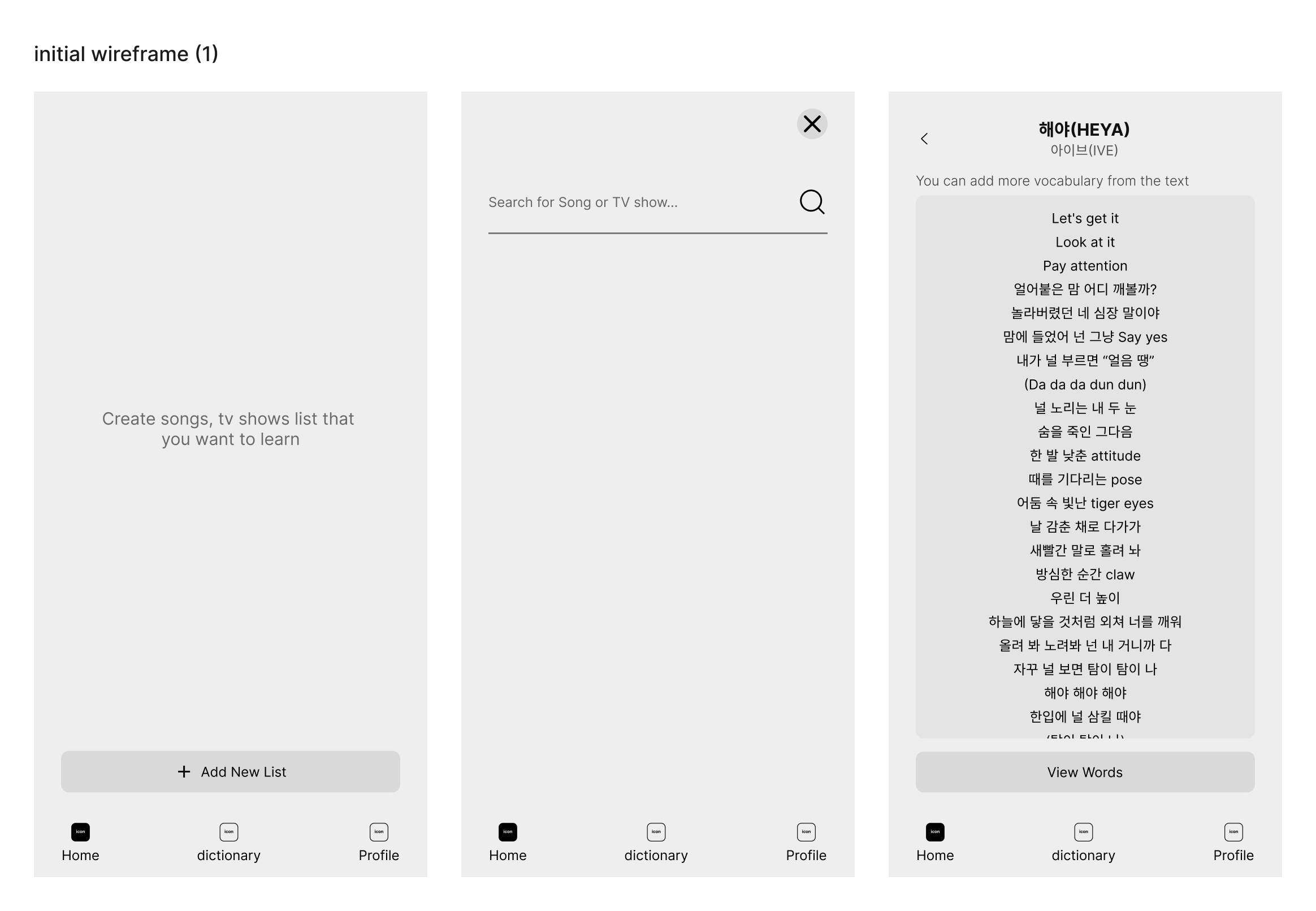
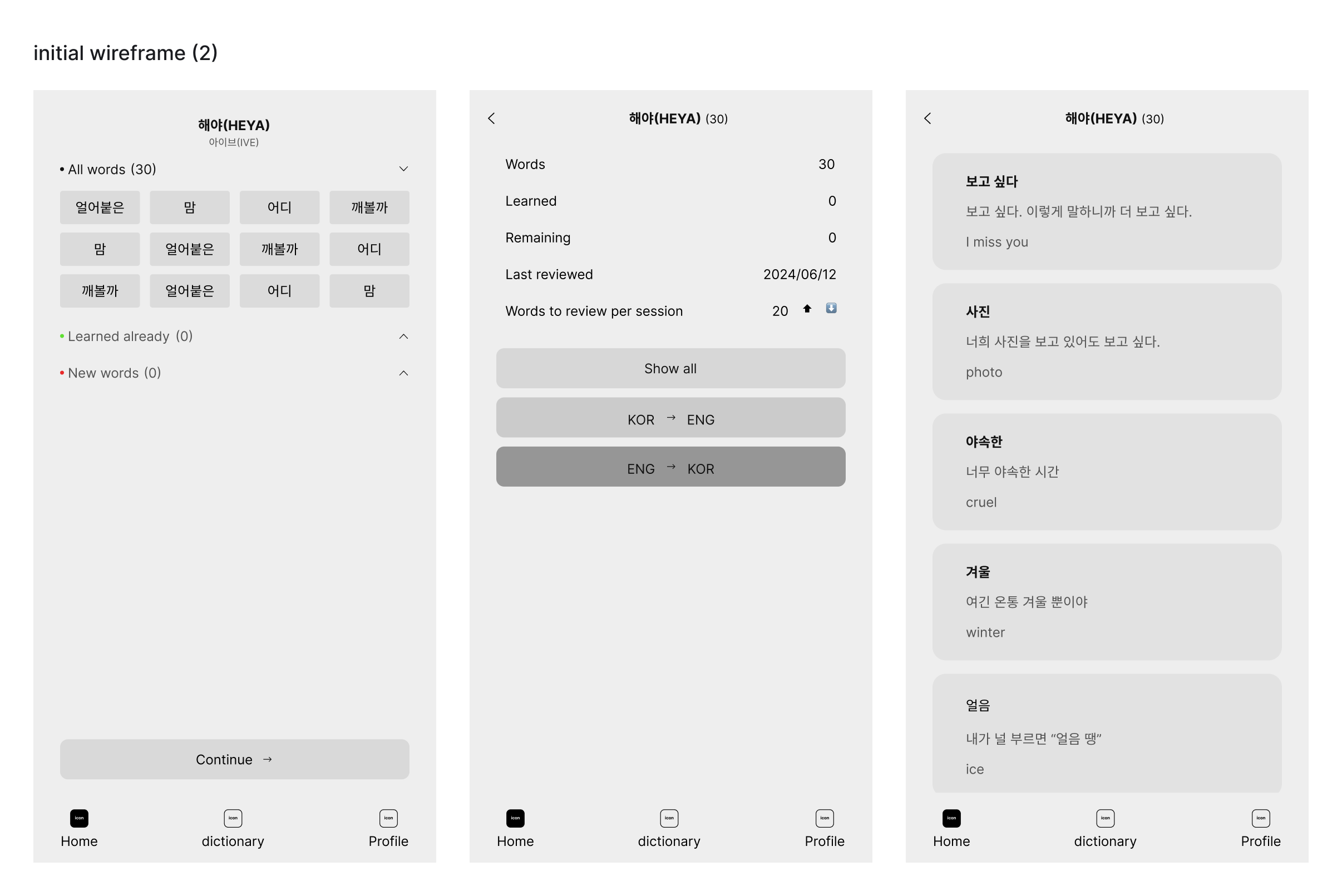
Initial ideation and user task flow development were followed by sketching app layouts and features through wireframes, with the goal of enabling users to freely learn vocabulary from K-content they enjoy.
Design
Shaping a brand and app
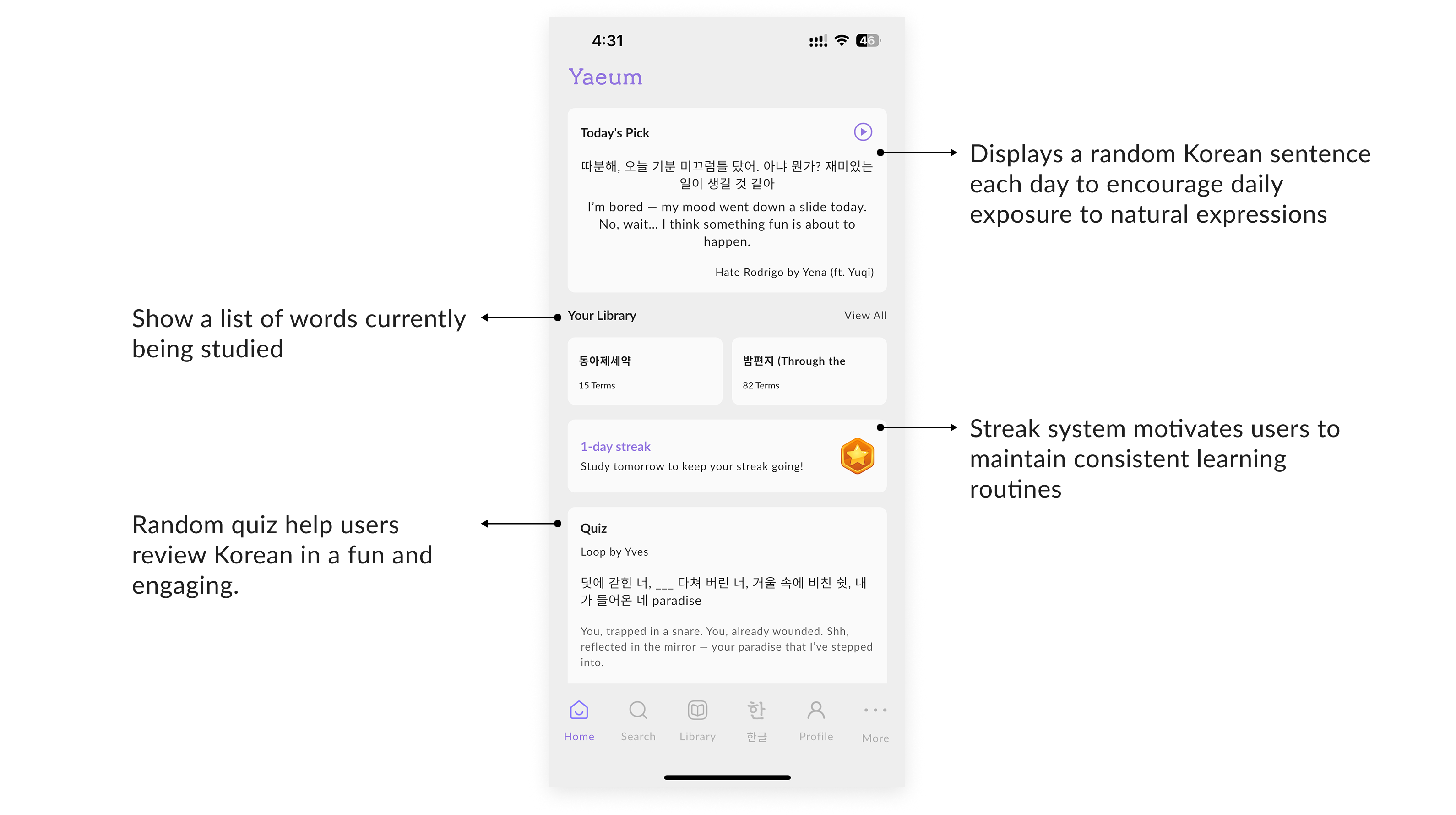
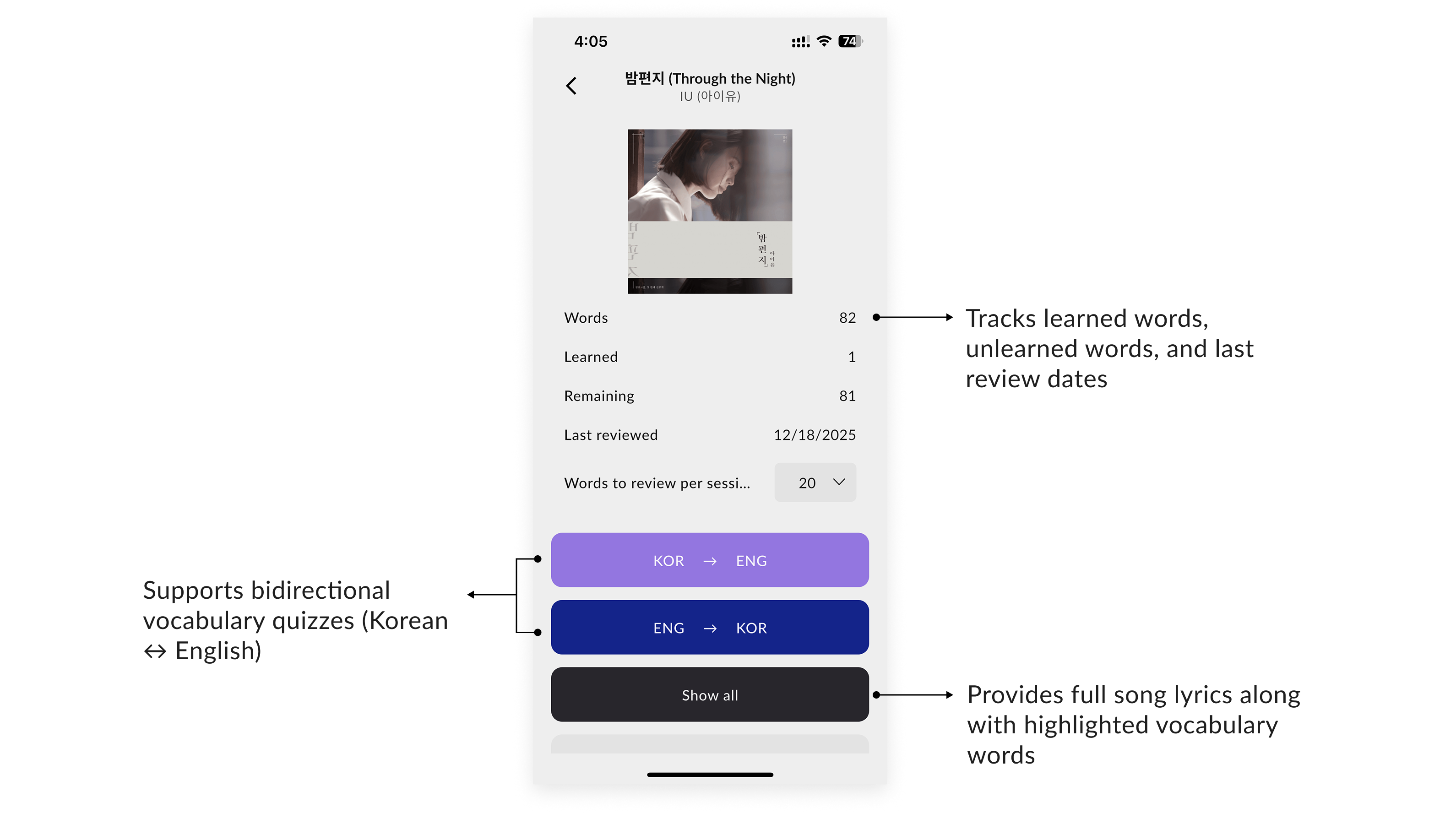
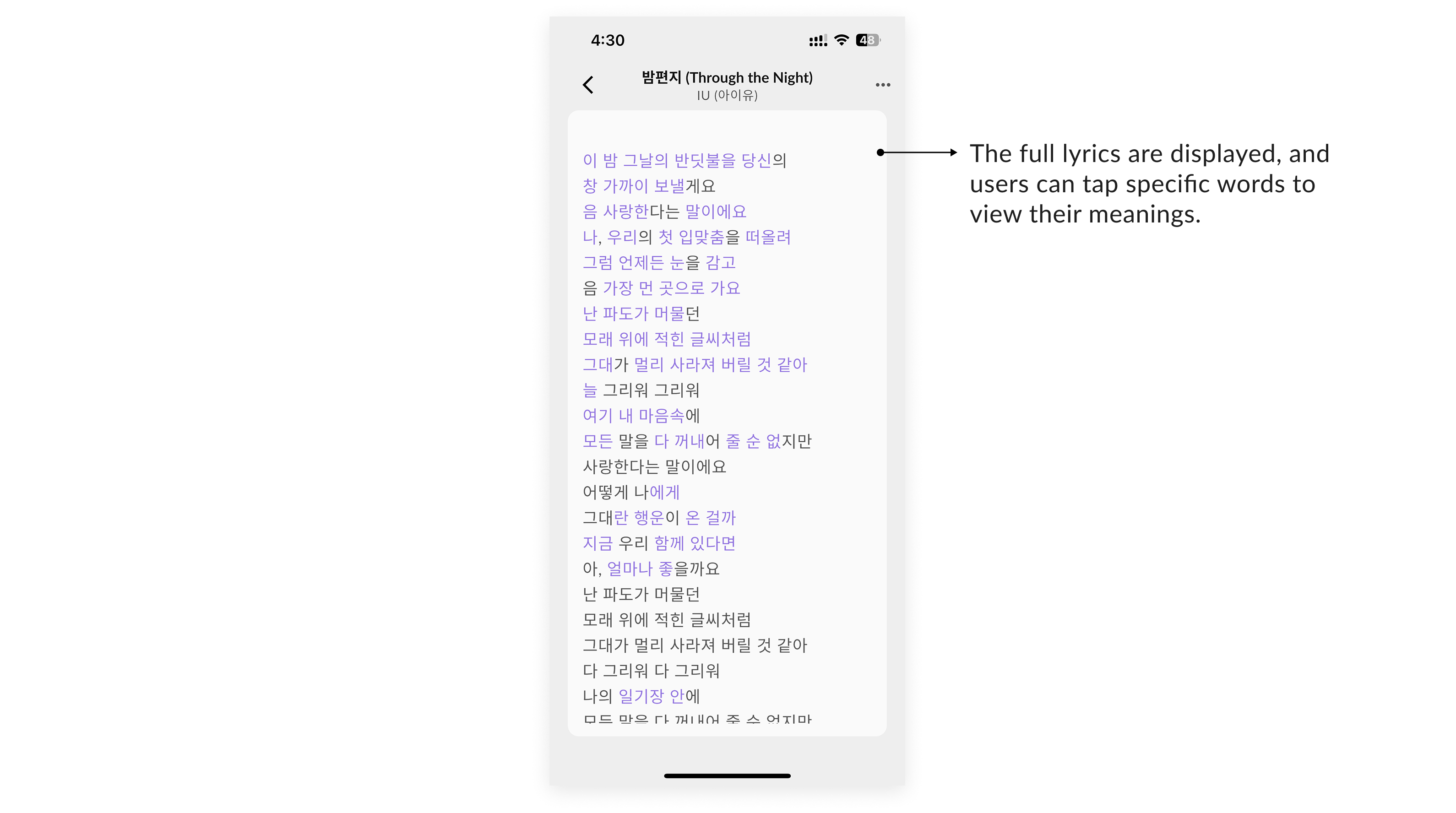
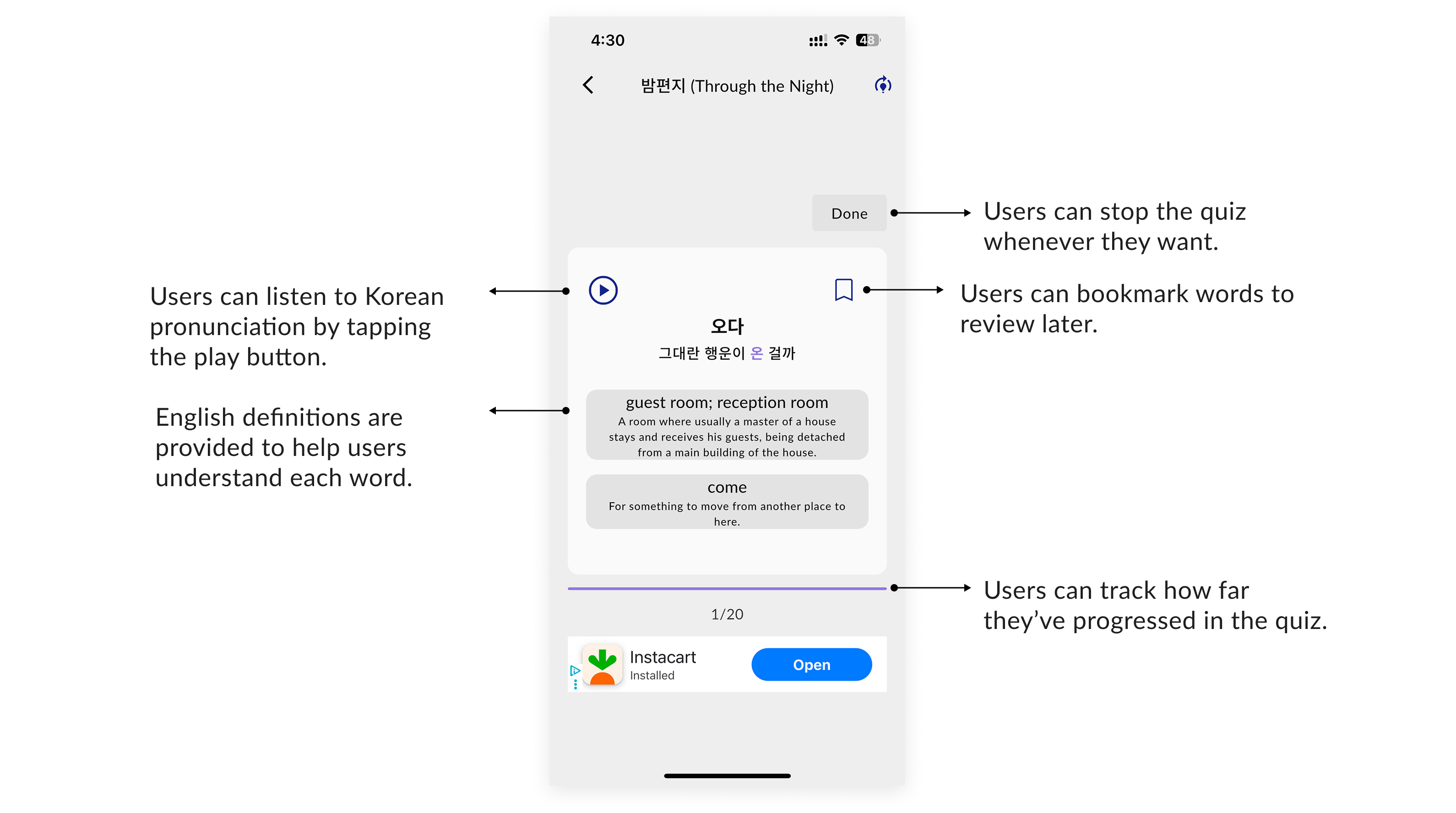
While designing Yaeum, my goal was to let users experience the vibrancy of Korean culture while learning the language enjoyably. The name Yaeum, meaning “night music,” reflects the immersive focus of listening to music at night, translated into a language learning experience.
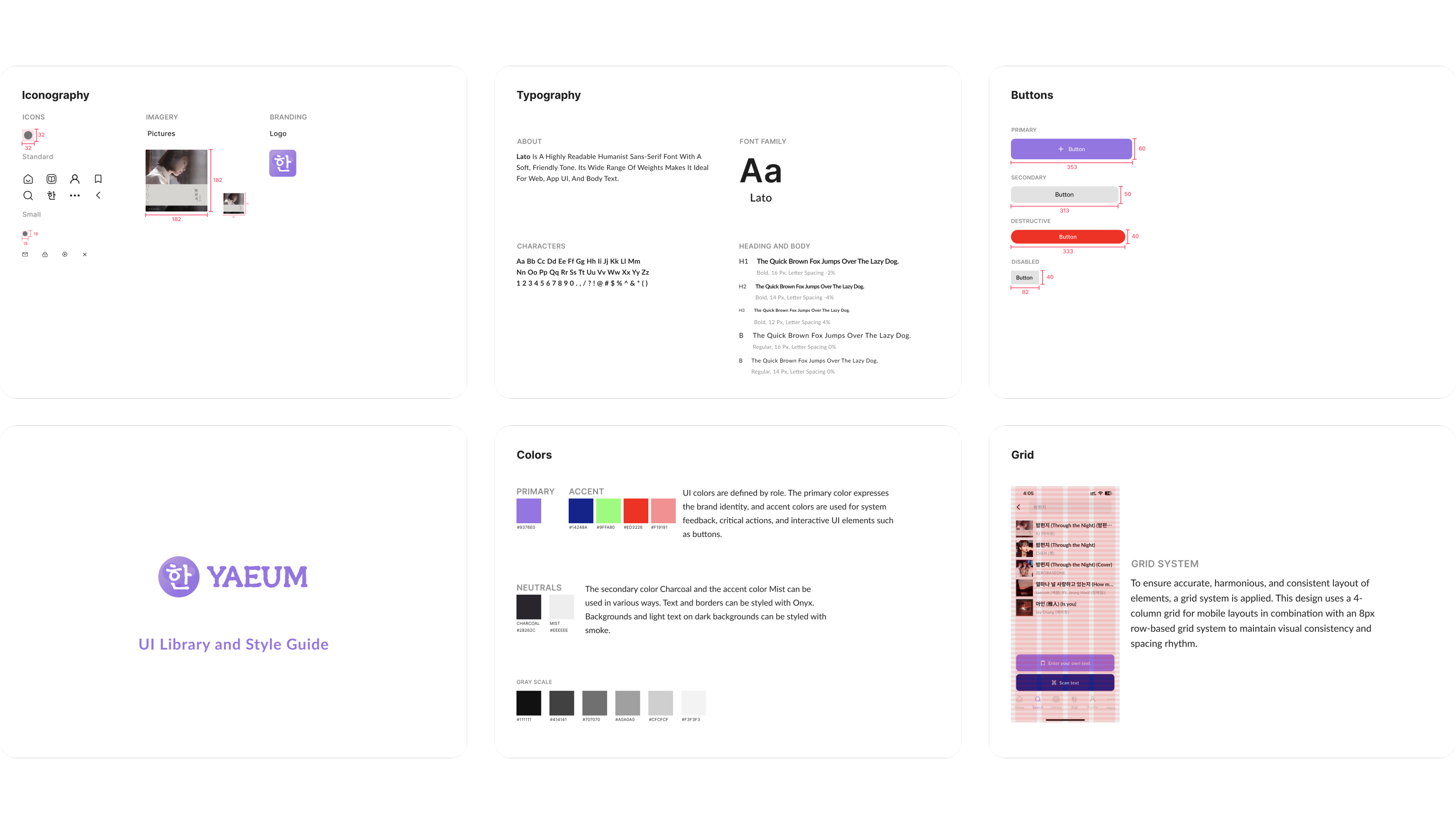
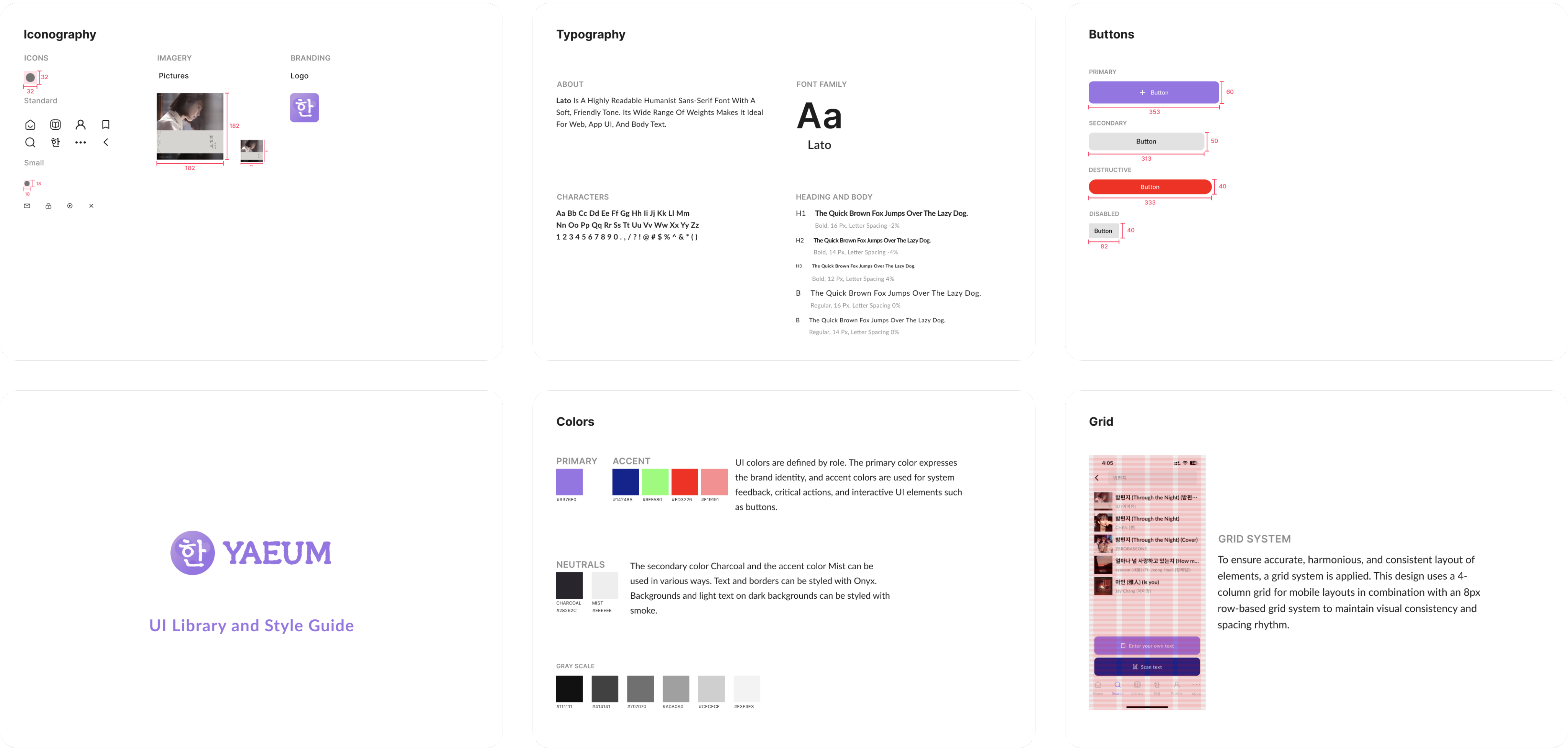
Creating Yaeum’s visual identity, from the color palette to a logo inspired by traditional Hangul fonts, was rewarding. The UI balances efficient learning flows and modern app trends with the brand’s unique colors, typography, and imagery, delivering both Korean sensibility and an immersive experience. A design system ensures consistency throughout the app.
Despite limited time and resources, close collaboration with developers brought Yaeum’s story to life. This project went beyond app design, exploring how to naturally convey Korean culture and language learning.
Validation & Testing
Problem Detection & Feedback
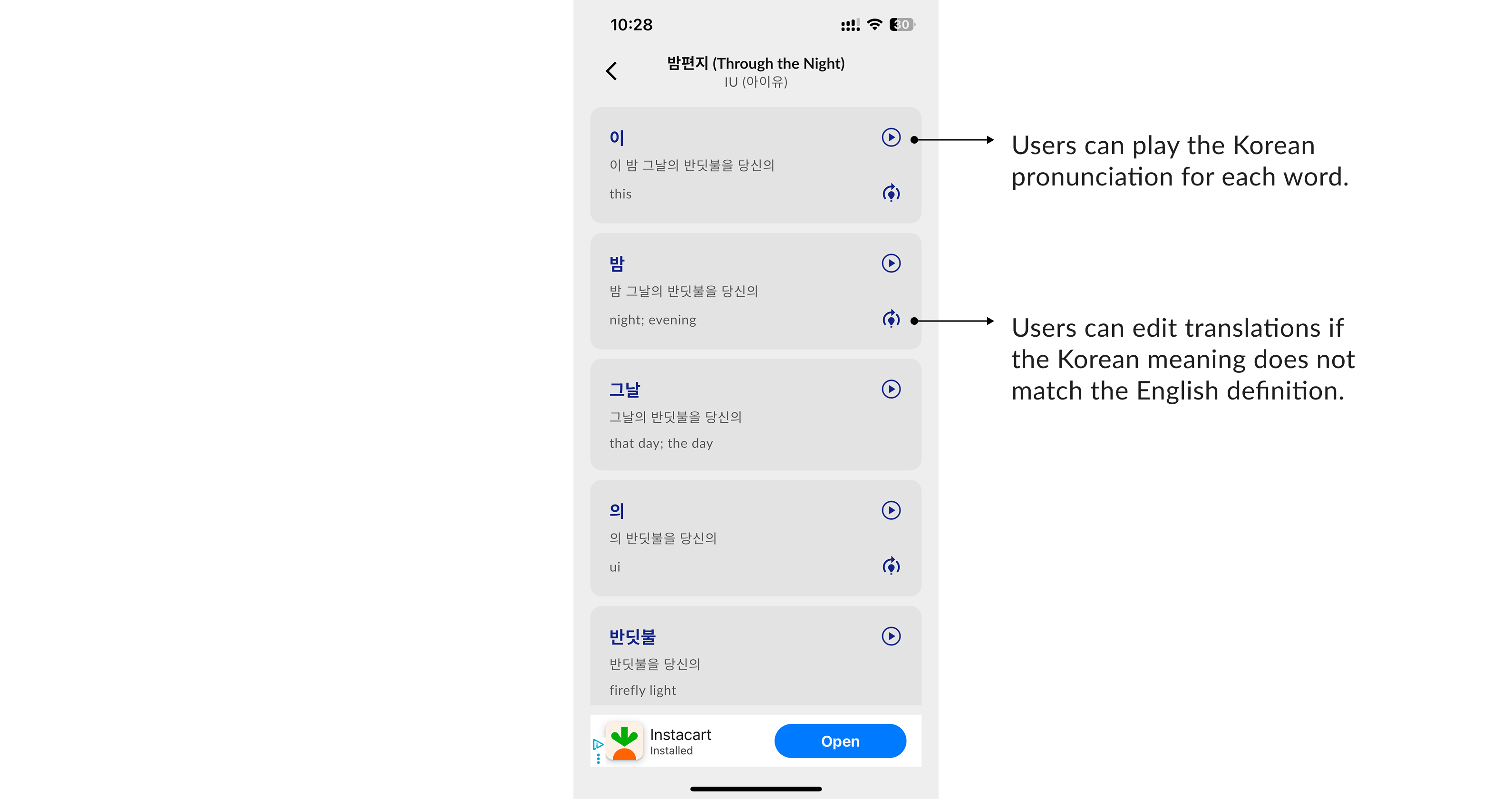
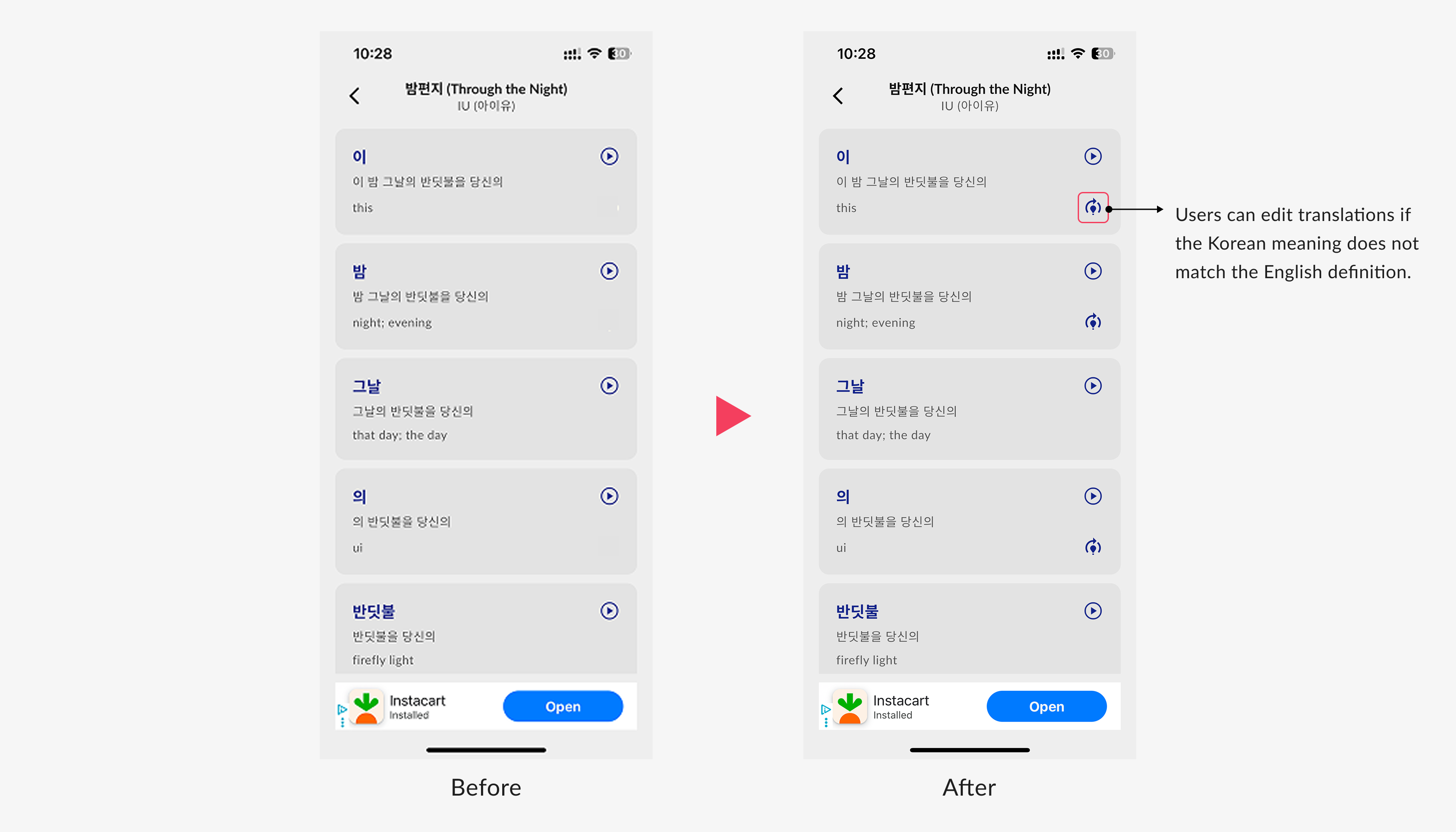
During a design review, I identified several cases where the AI-generated word definitions did not accurately reflect the context of the song lyrics. Since data accuracy is critical to user trust in an educational product, I raised these issues and discussed them with the developer.
Improvement through Collaboration
Based on this feedback, the developer introduced the KOMORAN NLP library and the National Institute of the Korean Language’s dictionary (krdict) API. This significantly improved the accuracy of word matching and context-based meaning interpretation. To further address any remaining technical inaccuracies, a user reporting system was added, enabling continuous data quality management and strengthening overall service reliability.
Thank you for reading this case study!
Thank you for reading this case study!
All Works
Next

Yaeum
A mobile app for learning Korean vocabulary through K-pop, K-dramas, and real texts
Yaeum is a mobile app that helps learners build Korean vocabulary using content they love, such as K-pop lyrics, K-dramas. By turning real Korean content into personalized word lists and quizzes, Yaeum makes vocabulary learning more relevant, engaging, and effective.
Background
When Motivation Isn’t the Problem
Many of my foreign friends who are learning Korean turn to K-pop and Korean dramas as one of their primary ways to build vocabulary. These moments are when motivation is highest, and learning feels immersive rather than academic.
However, I noticed a recurring frustration. When unfamiliar words or sentences appeared, they would pause the content and look them up using Google or dictionary apps. While this behavior showed strong curiosity, it happened repeatedly and resulted in vocabulary being scattered across searches, notes, and screenshots.
Over time, these in-the-moment lookups rarely turned into structured learning. Words were forgotten, lists were not revisited, and the learning experience became fragmented and inefficient.
This observation made me realize that the problem was not motivation, but the lack of a system to organize and reuse vocabulary encountered through content. This insight became the starting point for Yaeum.
Research
Learning Korean through K-Content
To validate these observations, I studied how beginner to intermediate learners engage with Korean through K-content. While they often look up unfamiliar words and take notes in the moment, the lack of structure and continuity leads to fragmented vocabulary learning. These insights were derived from interviews.
In-the-moment learning: Learners tend to look up vocabulary only when curiosity arises during content consumption, rather than through planned study sessions.
Fragmented workflows: Switching between music or video platforms, search engines, and note-taking tools disrupts immersion and learning momentum.
High effort, low retention: Although learners invest time searching and writing down words, these vocabulary lists are rarely revisited or effectively retained.
Approach
Turning moments of curiosity into Korean learning
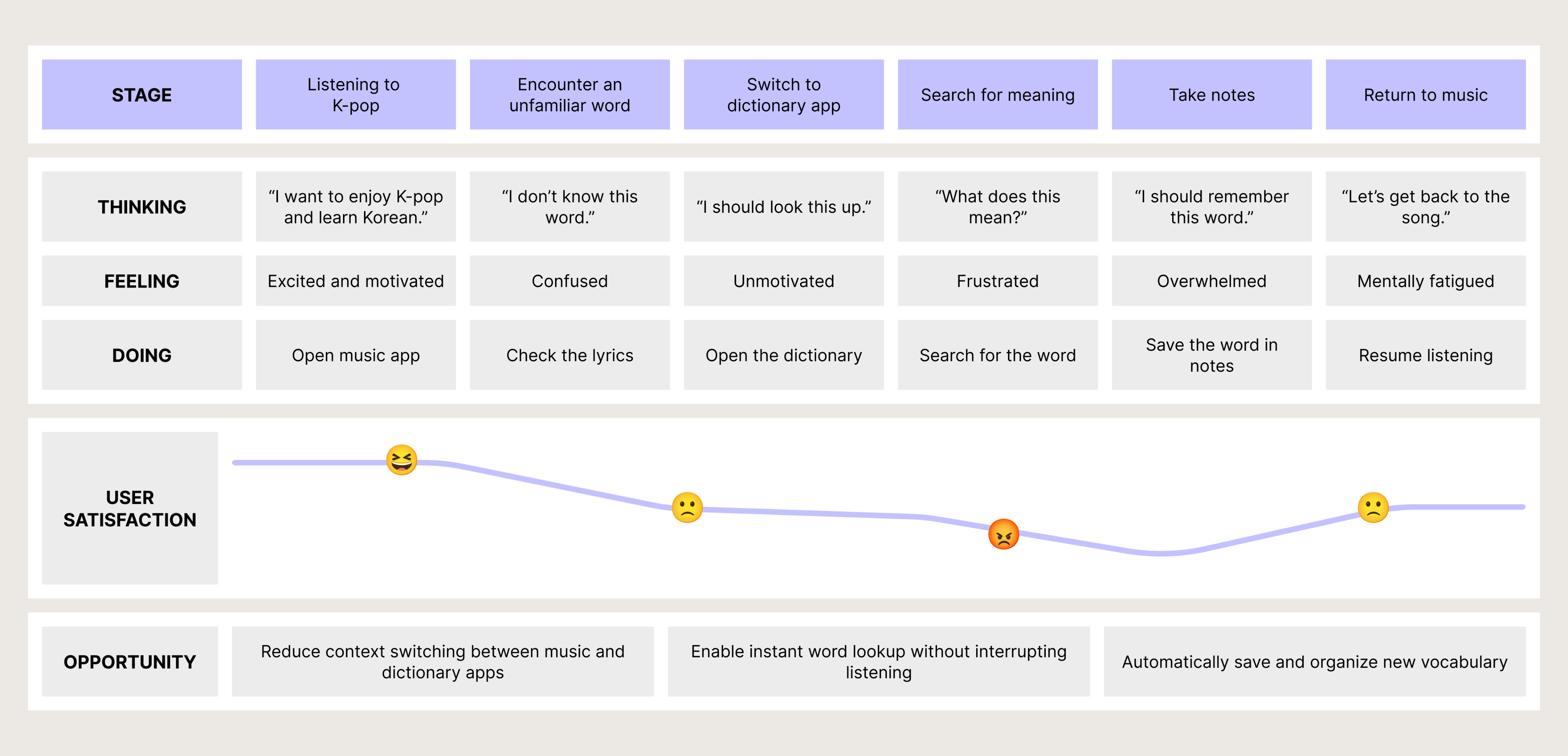
Creating a user persona named Alex from interview insights, I developed an experience map to empathize with her journey of learning Korean through K-content. This led to the idea of a service that allows users to search for music and receive vocabulary lists and quiz exercises generated from song lyrics. The main functionality focuses on helping users stay engaged in language learning through vocabulary study and quizzes based on real Korean content.
Initial ideation and user task flow development were followed by sketching app layouts and features through wireframes, with the goal of enabling users to freely learn vocabulary from K-content they enjoy.
Design
Shaping a brand and app
While designing Yaeum, my goal was to let users experience the vibrancy of Korean culture while learning the language enjoyably. The name Yaeum, meaning “night music,” reflects the immersive focus of listening to music at night, translated into a language learning experience.
Creating Yaeum’s visual identity, from the color palette to a logo inspired by traditional Hangul fonts, was rewarding. The UI balances efficient learning flows and modern app trends with the brand’s unique colors, typography, and imagery, delivering both Korean sensibility and an immersive experience. A design system ensures consistency throughout the app.
Despite limited time and resources, close collaboration with developers brought Yaeum’s story to life. This project went beyond app design, exploring how to naturally convey Korean culture and language learning.
Validation & Testing
Problem Detection & Feedback
During a design review, I identified several cases where the AI-generated word definitions did not accurately reflect the context of the song lyrics. Since data accuracy is critical to user trust in an educational product, I raised these issues and discussed them with the developer.
Improvement through Collaboration
Based on this feedback, the developer introduced the KOMORAN NLP library and the National Institute of the Korean Language’s dictionary (krdict) API. This significantly improved the accuracy of word matching and context-based meaning interpretation. To further address any remaining technical inaccuracies, a user reporting system was added, enabling continuous data quality management and strengthening overall service reliability.
Thank you for reading this case study!
Thank you for reading this case study!

All Works
Next Case Study


Yaeum
A mobile app for learning Korean vocabulary through K-pop, K-dramas, and real texts
Yaeum is a mobile app that helps learners build Korean vocabulary using content they love, such as K-pop lyrics, K-dramas. By turning real Korean content into personalized word lists and quizzes, Yaeum makes vocabulary learning more relevant, engaging, and effective.
Background
When Motivation Isn’t the Problem
Many of my foreign friends who are learning Korean turn to K-pop and Korean dramas as one of their primary ways to build vocabulary. These moments are when motivation is highest, and learning feels immersive rather than academic.
However, I noticed a recurring frustration. When unfamiliar words or sentences appeared, they would pause the content and look them up using Google or dictionary apps. While this behavior showed strong curiosity, it happened repeatedly and resulted in vocabulary being scattered across searches, notes, and screenshots.
Over time, these in-the-moment lookups rarely turned into structured learning. Words were forgotten, lists were not revisited, and the learning experience became fragmented and inefficient.
This observation made me realize that the problem was not motivation, but the lack of a system to organize and reuse vocabulary encountered through content. This insight became the starting point for Yaeum.
Research
Learning Korean through K-Content
To validate these observations, I studied how beginner to intermediate learners engage with Korean through K-content. While they often look up unfamiliar words and take notes in the moment, the lack of structure and continuity leads to fragmented vocabulary learning. These insights were derived from interviews.
In-the-moment learning: Learners tend to look up vocabulary only when curiosity arises during content consumption, rather than through planned study sessions.
Fragmented workflows: Switching between music or video platforms, search engines, and note-taking tools disrupts immersion and learning momentum.
High effort, low retention: Although learners invest time searching and writing down words, these vocabulary lists are rarely revisited or effectively retained.

Alex Miller
Age
Location
Work
Education
25
New York, USA
Marketer
Bachelor’s degree
About
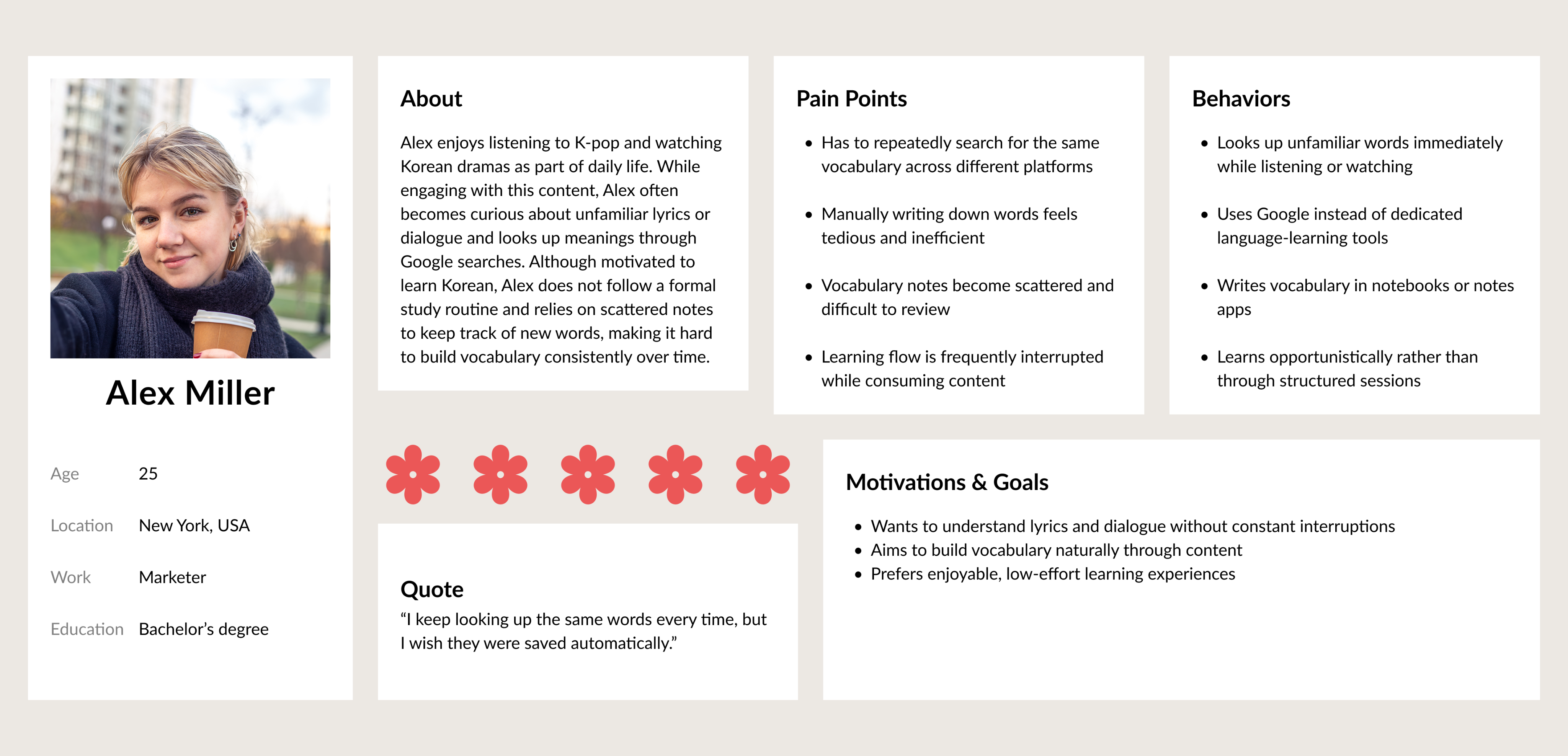
Alex enjoys listening to K-pop and watching Korean dramas as part of daily life. While engaging with this content, Alex often becomes curious about unfamiliar lyrics or dialogue and looks up meanings through Google searches. Although motivated to learn Korean, Alex does not follow a formal study routine and relies on scattered notes to keep track of new words, making it hard to build vocabulary consistently over time.
Pain Points
- Has to repeatedly search for the same vocabulary across different platforms
- Manually writing down words feels tedious and inefficient
- Vocabulary notes become scattered and difficult to review
- Learning flow is frequently interrupted while consuming content
Behaviors
- Looks up unfamiliar words immediately while listening or watching
- Uses Google instead of dedicated language-learning tools
- Writes vocabulary in notebooks or notes apps
- Learns opportunistically rather than through structured sessions

Quote
“I keep looking up the same words every time, but I wish they were saved automatically.”
Motivations & Goals
- Wants to understand lyrics and dialogue without constant interruptions
- Aims to build vocabulary naturally through content
- Prefers enjoyable, low-effort learning experiences
Approach
Turning moments of curiosity into Korean learning
Creating a user persona named Alex from interview insights, I developed an experience map to empathize with her journey of learning Korean through K-content. This led to the idea of a service that allows users to search for music and receive vocabulary lists and quiz exercises generated from song lyrics. The main functionality focuses on helping users stay engaged in language learning through vocabulary study and quizzes based on real Korean content.
Initial ideation and user task flow development were followed by sketching app layouts and features through wireframes, with the goal of enabling users to freely learn vocabulary from K-content they enjoy.
Design
Shaping a brand and app
While designing Yaeum, my goal was to let users experience the vibrancy of Korean culture while learning the language enjoyably. The name Yaeum, meaning “night music,” reflects the immersive focus of listening to music at night, translated into a language learning experience.
Creating Yaeum’s visual identity, from the color palette to a logo inspired by traditional Hangul fonts, was rewarding. The UI balances efficient learning flows and modern app trends with the brand’s unique colors, typography, and imagery, delivering both Korean sensibility and an immersive experience. A design system ensures consistency throughout the app.
Despite limited time and resources, close collaboration with developers brought Yaeum’s story to life. This project went beyond app design, exploring how to naturally convey Korean culture and language learning.
Validation & Testing
Problem Detection & Feedback
During a design review, I identified several cases where the AI-generated word definitions did not accurately reflect the context of the song lyrics. Since data accuracy is critical to user trust in an educational product, I raised these issues and discussed them with the developer.
Improvement through Collaboration
Based on this feedback, the developer introduced the KOMORAN NLP library and the National Institute of the Korean Language’s dictionary (krdict) API. This significantly improved the accuracy of word matching and context-based meaning interpretation. To further address any remaining technical inaccuracies, a user reporting system was added, enabling continuous data quality management and strengthening overall service reliability.
Thank you for reading this case study!
All Works
Next Case Study